Categories
Amlogic Community Frontpage Article Linux Kernel

How We Improved AmLogic Support in Mainline Linux

It was a match made in heaven: two years ago AmLogic and BayLibre joined forces to bring top-notch support for AmLogic SoCs into the mainline Linux kernel.

Since that time AmLogic has continued to become one of the most relevant and widely used silicon vendors in the world. Similarly, BayLibre has expanded the variety of SoCs, drivers and frameworks supported upstream all while supporting a growing number of OEMs basing their products off of recent kernel releases.

Along the way Baylibre has collaborated with a great community of product makers, kernel hackers and hobbyists to improve the AmLogic Meson SoC support in mainline Linux. We’ve added support for 64-bit SoCs, new drivers, and we’ve become maintainers for the AmLogic platform in Linux.

Our goal is straightforward: AmLogic system-on-chip processors should be so well-supported in the mainline Linux kernel that OEMs will go to market using the latest stable kernel release.

Last year at Embedded Linux Conference 2017 and this year at Linux Conf Australia, Neil Armstrong gave a well-received talk on our work. This post expands on Neil’s presentation and provides an update on some of the changes we’ve been involved with recently.

The Linux Meson project

The Linux Meson project is an effort to get support for the ARM-based SoCs produced by AmLogic into the upstream Linux kernel and GNU/Linux distributions. AmLogic chips are found in many Android-based multimedia devices such as set-top boxes, smart TVs, projectors, and tablets but are also starting to appear in products in the smart speaker market. Popular consumer products and community boards using the AmLogic Meson SoC include:

  • Amazon Fire TV (gen3)
  • Wetek Play/Hub
  • Nexbox A1/A95
  • Hardkernel ODROID-C2
  • Tronsmart Vega S96
  • R-Box Pro
  • HwaCom AmazeTV
  • Libre Tech CC (a.k.a “Le Potato”)
  • Khadas VIM and VIM2
  • NanoPi K2

AmLogic provides a kernel release and SDK that supports their hardware but it’s a heavily-modified 3.10-based or 3.14-based kernel for Android. Thankfully, most of the changes are confined to the `drivers/amlogic` directory and it has been possible to use them as a starting point to write the upstream support.

Carlo Caione added the initial support for the 32-bit Meson6 SoC in Linux 3.18, with Beniamino Galvani adding support for Ethernet and Andreas Färber contributing code for the GXBB platform. Since then, support has been added for Meson8, Meson8b, and the 64-bit ARM Meson GXBB, Meson GXL and GXM SoCs and a whole host of hardware. Codenames for the 64-bit SoCs are used in the kernel source and the following table shows how they map to their respective product names:


Codename Product name
GXBB S905
GXL S905X, S905D
GXM S912
AXG A111, A112, A113


Here’s How We Helped

Our efforts have mainly been focused on adding support for the 64-bit Meson SoCs. Kevin Hilman generalized the boot and serial console code for the 64-bit AmLogic family of SoCs so that more boards could be supported, starting with the Hardkernel ODROID-C2).

Michael Turquette reworked the Meson SoC clock driver to move to the `platform_driver` API and replaced the dynamic configuration code with statically initialized data. That was in preparation for adding clock driver support for the S905 SoC. We’ve also added S905 AO (Always-On) clock and reset controller drivers and support for PWM, RNG, Watchdog, IR, I2C, SPIFC devices.

Because some of AmLogic SoCs use a legacy version of the System Control and Power Interface (SCPI) protocol (pre-v1.0), we pushed changes to the upstream SCPI driver to support it. The SCPI driver is used for Dynamic Voltage and Frequency Scaling (DVFS) with the CPUFreq subsystem to dynamically alter the processor’s speed.

We’ve added a driver for the AmLogic SPI Communication Controller (SPICC) that’s capable of full-duplex transfers up to 30MHz. And in v4.10 Kevin added a brand new SD/eMMC driver that supports the host controller found on the AmLogic S905/GX* family of SoCs.

Neil wrote the AmLogic Meson DRM driver and has added HDMI support since his last update during his talk at Embedded Linux Conference 2017.

As the following graph shows, the number of Meson patches merged into the kernel has risen steadily over the last few kernel releases, and Baylibre is responsible for hundreds of them.

AmLogic kernel commits and BayLibre contributions
And because of our knowledge of the Meson code, we’ve had the honour of becoming (co-)maintainers for the majority of it.

  • Meson SoC code (Kevin Hilman)
  • DRM display driver (Neil Armstrong)
  • AO-CEC driver (Neil Armstrong)
  • Meson SoC clock framework (Neil Armstrong and Jerome Brunet)

As the number of supported boards has grown, it’s become increasingly important to maintain quality across all devices. For that, we’ve leaned heavily on kernelci.org. Baylibre is a founding member of kCI and you can expect more details in an upcoming blog post.

kernelci.org has been extremely useful for our AmLogic work. Part of our lab is made up of 8 AmLogic Meson boards which we use to check for regressions across 6 kernel trees. The kernelci.org infrastructure recently caught a kernel regression in the SCPI code which resulted in CPUFreq failures on boot. Thanks to kernelci.org and our collection of Meson boards, we were able to get the offending patch reverted before the final v4.15 release.


Links to Community Resources

AmLogic Meson support has come a long way in the last two years. That progress has been possible thanks to the supportive Linux Meson community and the kernel hackers (shout out to Martin Blumenstringl for his contributions as well as Carlo Caione and Andreas Färber for their early work and ongoing reviews) helping to improve the upstream AmLogic code. There’s lots more to come and we are currently working on support for the new AXG SoC (including audio) which is targeted at the smart speaker market.

If you want to know more about Linux Meson development you can subscribe to the linux-amlogic mailing list or join the #linux-amlogic IRC channel on irc.freenode.net. Also, the Linux Meson wiki is updated as support for new devices and SoCs lands in mainline Linux.


Post header image by Hardkernel – http://odroid.com/dokuwiki/doku.php?id=en:odroid-c2, CC BY-SA 3.0, Link

Categories
Amlogic Community Frontpage Article Linux Kernel News Open-source

U-Boot v2018.01 released, our contributions

BayLibre has continued contribution to the open-source community as seen with this new version of U-Boot v2018.01, released on 9 Jan 2018.

Here is a summary of our contributions:

Amlogic SoC family:

Add support for the Meson GXL Family by :

  • Adding pinctrl support, based on excellent work of Beniamino Galvani
  • Adding Internal PHY Support + fixups for reliability
  • Add support for dynamic reserved memory
  • Adding support for S905X Based boards :
    • P212 reference board
    • Khadas VIM
    • LibreTech-CC
  • Neil Armstrong becomes maintainer of these freshly added boards

This version of U-Boot for Amlogic GXL SoCs will need to wait for Linux 4.16 to be released, or is compatible with the LibreTech-cc 4.14 stable linux tree for the LibreTech-CC board.

Khadas has released an image with this version of U-Boot and Linux Mainline for the Khadas VIM board here.

Misc :

  • fat: Use cache aligned buffers for fat_opendir
Categories
Community Frontpage Article Linux Kernel News Open-source

Linux Kernel v4.14 released, our contributions

Linux Kernel v4.14 released

BayLibre has continued our contribution to the Linux community as seen with this new version of Linux Kernel v4.14, released on Nov 12 2017.  An excellent summary of this release can be found at KernelNewbies.

Here is a summary of our contributions, organized by SoC family and a summary graph of contributions by developer.

Amlogic SoC family:

  • Add support for eMMC HS200 and SD SRD104 modes to GX MMC Controller
  • Fix GX MMC Controller clocking scheme
  • Add GPIO Lines names to the following Single Board Computers :
    • LibreTech-CC
    • Nanopi K2
    • Khadas VIM
  • Add support for the HDMI CEC Controller on Meson GX SoCs

TI DaVinci SoC family:

  • musb: musb_cppi41: Configure the number of channels for DA8xx


Categories
Amlogic Community Frontpage Article Linux Kernel Open-source Partners

Kernel Recipes: Mainline Linux on AML-S905X-CC: Le Potato

At Kernel Recipes this year, BayLibre was proud to partner with the Libre Computer Project to give away around 30 “Le Potato” boards to attendees.  Kernel Recipes is already known for its throw microphone, but this year each speaker threw a “Le Potato” board at the audience.

For those who received the board, pre-built images (to be written to a microSD card, at least 4Gb) are available here :

What works:

  • Quad-Core Cortex-A53 @ 1.5GHz with Dynamic Voltage and Frequency Scaling (DVFS)
  • Penta-Core Mali-450 MP3 GPU limited to X11 (experimental) and Framebuffer acceleration
  • RS-232 TTL serial console on UART header and 40-pin header using DT Overlay
  • microSDCard SD/SDHC/SDXC up to SDR104 (UHS-I) speed
  • Optional eMMC 5.1 up to HS200 speed
  • SDIO up to SDR104 on 40-pin header
  • I2C, SPI, PWM, ADC on 40-pin header
  • Infrared Receiver
  • Hardware Watchdog
  • Up to 100Mb Full Duplex Ethernet
  • 4x USB2.0 Type A ports
  • 480i/576i CVBS Analog Output on AV Jack
  • Up to 1080p60 Full HD Output with CEC and Stereo Digital Audio

What doesn’t work (yet) :

  • 4k2k HDMI 2.0a modes, 7.1 and compressed Digital Audio
  • Mali-450 MP3 GPU Acceleration for Wayland
  • Analog and 7.1 I2S Digital audio output
  • Hardware Accelerated Video decoding/encoding for H.264/H.265/VP9

How to build and boot your own kernel from mainline:

For Overlays support, please follow the steps on https://github.com/libre-computer-project/libretech-overlays/blob/for-4.13.y/README.md

For Questions, please find us on the IRC channel #linux-amlogic (on Freenode) or ask questions on linux-amlogic@lists.infradead.org

Categories
Community Conferences Frontpage Article Linux Kernel Open-source

Embedded and Kernel Recipes speakers

BayLibre’s team experts talk in the Open source community

It’s the end of holidays and we’re ready to tackle September in fine fettle.
Two major conferences are taking place in the Embedded and Open source community.
BayLibre is sponsors at those events.
We are longing for them for good reasons!

Two Jedi of our team, will demonstrate their power as embedded systems experts.

  • Neil Armstrong (yes the real one !) : Embedded system expert and software engineer, one of the Embedded Recipes speakers
  • Kevin Hilman : Linux Kernel expert, one of the Kernel Recipes speakers

Embedded Recipes

The first edition of the Embedded Recipes conference, #er2017, will take place in Paris, the 26th of September 2017.

Just as it’s big sister, Kernel Recipes, the objective is to bring together a developer community.

That day will be dedicated to Embedded Open Source actors.

Share your experience with us. 

Neil Armstrong : From Embedded Recipe speakers

Software and Linux Embedded System Engineer

9 years of passion for embedded systems, Linux Expert.

Neil was keen on computing at the youngest age. He obtains his degree of engineering in computer science from Polytech Nice-Sophia.

He got into Neotion as a Linux embedded system engineer.

From this experience he has got increasingly interested in the Open source community.

Then, in 2015 he decides, to join the team BayLibre.


Kernel Recipes

We wish a happy 6th edition to Kernel Recipes!

From the 27th to the 29th September 2017 in Paris.

A great, human and professional experience as always.

A unique track of conferences on subjects as varied as:

  • Open source hardware,
  • Core,
  • Security,
  • Experience feedback,
  • Industrialization processes
  • and so many more…

Kevin Hilman: From Kernel recipes speakers

Linux Kernel Consulting and Engineering

20 years of engagement with Embedded Linux. Expert in power management. Upstream maintenance of Kernel subsystems.

Early in computer science, he earns a Master of Science in Electrical Engineering from the University of Seattle.

Then in 2003 he decides to settle down in France and joins Texas Instrument. He works there as a Linux Kernel developer and meet his future collaborators.

Later he returns Seattle and Texas Instrument for a few years. He finally decides to join the team BayLibre.


How to Subscribe ?

The subscription is limited so unfortunately there are no more places left.

Think about it next year and be sure to subscribe!

Embedded Recipes

Kernel Recipes

Categories
Community Frontpage Article Linux Kernel News Open-source

Linux Kernel v4.13 released, our contributions

Linux Kernel v4.13 released

BayLibre has continued our contribution to the Linux community as seen with this new version of Linux Kernel v4.13, released on Sept 3rd.

For this version we supplied:

  • multiple team members
  • many work hours
  • several cups of coffee
  • and a few pastries

An excellent summary of this release can be found at KernelNewbies.

Here is a summary of our contributions, organized by SoC family and a summary graph of contributions by developer.

Amlogic SoC family:

  • Add S905x based libretech-cc “Le Potato” board support (Succesfully backed on kickstarter)
  • Fix PWM for AO Domain
  • Add HDMI Nodes for more boards (p212, p230, Khadas VIM, Wetek Play2)
  • Support for the SPICC controller added
  • And missing GXL pinctrl pins

TI DaVinci SoC family:

  • da850: Enable CPPI 4.1 DMA to USB OTG controller
  • da850: vpif: adaptions for DT support

Various

  • Fix for Mediatek MMC driver


Categories
Community Frontpage Article Linux Kernel News Open-source

Linux v4.12 released, BayLibre contributions

We are happy to announce the Linux v4.12 release on July the 2nd.

Baylibre is pleased to have contributed with the Linux Kernel community to this new version.

An excellent summary of this release can be found at KernelNewbies.

Here is a summary of our contributions, organized by SoC family and a summary graph of contributions by developer.

Amlogic SoC family:

  • Clocks fixups and exports
  • GXL pinctrl fixups and more pins declarations
  • GXBB more pins declarations
  • Add MALI Node for GXBB and GXL
  • Add MALI Clocks support
  • Odroid-c2: Fix USB Hub and and GPIO pin labels
  • Add ADC Laddred buttons on P230 and Q200
  • Add support for HDMI Output on GXBB, GXL and GXM


TI DaVinci SoC family:

  • musb for da8xx
    • Add clock for CPPI 4.1 DMA engine
    • CPPI 4.1 DMA fixes
    • Detect aborted transfers
    • Add support of CPPI 4.1 DMA controller to DA8xx
  • Enable ohci for omapl138 lcdk
  • Add support for SATA on dm8168-evm
    • model the SATA refclk
    • add con_id for the SATA clock
    • add and enable the SATA node
    • davinci_all_defconfig: enable SATA modules
  • Fix da850 vpif display pinx
  • Fix davinci SPI DMA handling

Various

  • ASoC: add es7134 DAC driver and bindings
  • Enhancements to the DW-HDMI bridge driver


Categories
Community Frontpage Article Open-source Zephyr

Zephyr 1.8.0 released, BayLibre contributions

The new Zephyr 1.8.0 version released!

The 1.8 OS Zephyr Project version was launched on June 15th 2017.

To read more click here

— Zephyr Project (@ZephyrIoT) 16 juin 2017

A full changelog of this release are available on the project release notes page.

Thanks to major enhancements, it is now easier for contributors to submit pull requests by simplifying and streamlining the review and acceptance process.

Now supported in Zephyr 1.8 version :

Along the following STM32 Microcontrollers features :

  • Flash support for the STM32L4 family, merged in a common driver with the STM32F4 family driver
  • Support for the STM32F469XI SoC
  • Support for the STM32F407 SoC
  •  for the STM32L496 SoC
  • and for the STM32L432XC SoC


Categories
Conferences Frontpage Article Partners

Startup Weekend – Baylibre Sponsor SWNSA

BayLibre Sponsor SWNSA

La 5ème édition du Startup Weekend Nice Sophia Antipolis, aura lieu le 23 juin prochain à Nice.

Vous avez toujours souhaité créer votre propre entreprise?

Les idées fusent dans votre tête mais vous ne savez pas comment commencer?

Vous souhaitez obtenir des conseils d’experts et des retours d’expérience?

Vous voulez commencer rapidement?

La Startup Weekend Nice Sophia Antipolis est faite pour vous !

Le principe Startup weekend

Un weekend, soit 54 h, pour créer son projet de Startup!

Les participants doivent, avec l’aide d’experts, rendre leur projet viable.

Par la suite ils devront le présenter devant un jury, qui fera une sélection.

Les gagnants remportent des lots d’accompagnement pour les aider à se lancer concrètement dans leurs projets de création.


BayLibre sera enchanté et fier de pouvoir partager ses connaissances ainsi que son expérience et participer au lancement d’une jeune pousse.

Venez nous rejoindre nombreux au SWNSA Epitech Nice du 23 au 25 juin prochain.

Pour en savoir plus http://swnsa.fr/

Categories
Conferences Frontpage Article

Baylibre at the Innovation summit by Sierra Wireless

BayLibre will attend the Innovation Summit by Sierra Wireless, on June 13th, at the Eiffel Tower Novotel in Paris.

It’s a great opportunity to mingle with BayLibre and other industry experts in the IoT space.

BayLibre and Innovation

BayLibre is passionately involved in technology and innovation. Supporting clients such as Google, Texas Instruments, Fossil Group and so much more.

We are experts in low-level programming and development, on Linux embedded system and Android.

We are ready to commit ourselves to bring our support, competence and skills to your IoT projects.

Do not hesitate to contact us before, during and after the summit.

Discover some more about the Summit !

Categories
Conferences Frontpage Article

BayLibre at the innovation and technology fair

BayLibre will attend the Vivatech Innovation and Technology Fair, June 15th through the 17th, in Paris, Porte des Expositions. Come join us, we look forward to meeting you and sharing with you.

Innovation and technology are at the heart of BayLibre. We pride ourselves on our expertise in low-level software development, open source software, and world-class embedded Linux and Android know-how. We apply these skills and knowledge to our client projects in IoT, camera, mobile, wearables, health, automotive and consumer electronics markets.

We could not miss the opportunity to go to this event that brings together other industry experts and game-changers like us. We hope to see you soon, do not hesitate to contact us, we will be happy to have a chat with you.

Save

Categories
Frontpage Article STM32

Blocks + BayLibre smartwatch developer

BayLibre is collaborating with Blocks as smartwatch developer.

At BayLibre, our engineers get to work on some of the most interesting technology in world. We’re equally lucky to get to work with some of the coolest companies on the planet.

BayLibre, Blocks smartwatch developer

Earlier this month Blocks announced that they are collaborating with BayLibre to develop embedded software for their forthcoming modular smart watch. We’ve been working with Blocks for quite a while and we’re thrilled to speak more about this engagement publicly!

While BayLibre has collaborated with Blocks on various parts of the embedded software stack, the part that has been talked about the most has been the port of Zephyr to the STM32L4 family of SoCs.

Blocks has been ultra-savvy about using Open Source software where it makes sense in their product, and as a result they will get to claim the honor of being the first CE device in the world to ship with Zephyr OS on board.

Without going into too much detail, Zephyr forms a critical part of the component responsible for managing the modular parts of the watch. The brain of the system remains Android-based as outlined in a Kickstarter update by Blocks.

We’re big fans of open source software, emerging technologies and cool products here at BayLibre. We’ve managed to work on all three while supporting Blocks as they move closer and closer to their ship date. We’re looking forward to seeing this seriously stylish wrist wear out in the wild!

Save

Categories
Community Open-source Zephyr

Zephyr 1.7.0 released, BayLibre contributions

The 1.7.0 Release of the Zephyr Project was made on March 11th.

A full changelog of this release is available on the project release notes page.

BayLibre contributed support for the STM32L476 microcontroller series with the Nucleo-L476RG board.

In addition to the platform support, patches for the following devices were merged :

  • I2C for the whole STM32Lx family
  • UART support
  • Clocks control
  • GPIO/Pinmux control
  • EXTI Support


Categories
Community Frontpage Article Linux Kernel News Open-source

Linux v4.11 released, BayLibre contributions

The Linux v4.11 release was made on April 30th.

An excellent summary of this release can be found at KernelNewbies, and below is a summary of our contributions, organized by SoC family and a summary graph of contributions by developer.

Amlogic SoC family:

  • ADC laddered keys for P200 board
  • Export HDMI clocks
  • Add HDMI HPD/DDC pins functions

New boards:

  • Wetek Play (S905)
  • Wetek Hub (S905)

Linux v4.11 new release

TI DaVinci SoC family:

  • musb for da8xx
    • Manage CPPI 4.1 DMA interrupt in DSPS
    • Clean up
    • Detect aborted transfers
    • Fix host mode suspend
    • Add support of suspend / resume
    • Remove CPPI 3.0 quirk and methods
  • Enable ohci for omapl138 lcdk
  • Add support for SATA on da850-lcdk
    • model the SATA refclk
    • add con_id for the SATA clock
    • add and enable the SATA node
    • ahci-da850: un-hardcode the MPY bits
    • ahci-da850: add a workaround for controller instability
    • davinci_all_defconfig: enable SATA modules
    • ahci-da850: implement a workaround for the softreset quirk
    • ahci-da850: add device tree match table
  • Fix VGA output on da850-lcdk
    • add the vga-bridge node
    • add support for TI ths8135
  • Fix davinci: vpif_capture


Categories
Uncategorized

BayLibre new member of the Automotive Grade Linux

Automotive grade Linux

BayLibre part of the Automotive Grade Linux project

Today we are pleased to announce that we have joined Automotive Grade Linux, a Linux Foundation project.

AGL is an exciting effort involving more than 100 member companies. They are working together to define, improve and deploy the next generation software platform for the automotive industry.

Earlier this year BayLibre joined the Linux Foundation. We are big fans of the Linux Foundation. Their efforts to improve open source software is a goal shared by BayLibre. We’re proud to call ourselves a Member.

BayLibre is currently involved in two efforts within Automotive Grade Linux.

First we are contributing toward platform support and improving support for the SoCs and reference platforms within the OS release.

Then we are also helping to define and implement test, validation and continuous integration methodology for the project as a whole.

Both efforts hope to improve quality, interoperability and increase the pace of innovation within the Automotive Grade Linux project.

Read more at the Linux Foundation press release below:

https://www.automotivelinux.org/announcements/2017/04/27/automotive-grade-linux-welcomes-six-new-members

Categories
Board Farm Community Frontpage Article kernelci Lab Open-source

Kernel CI: Linux Kernel Testing at kernelci.org

The kernelci.org project aims to improve the quality of the mainline Linux kernel by improving testing and validation across the wide variety of diverse hardware platforms that run Linux.

There are so many different devices and platforms that run Linux, and Linux kernel development is moving so quickly that it is difficult to ensure that any given platform will remain working and stable with each Linux version.  As an example, the chart here shows the growth in the number of 32-bit ARM based devices supported by Linux, with the total number of unique devices as of v4.11 just shy of 1400!  That doesn’t even count the growing number of 64-bit ARM devices or any of the other architectures like x86 or MIPS.

With such an incredible range of supported hardware, how can the Linux kernel community continue to ensure that all of this hardware remains well supported and evolves with the rest of the Linux kernel?

The kernelci.org project set out to help solve that problem.

During the development cycle of the Linux kernel, whenever there are changes to the source-code repository, the kernel is built in a wide variety of configurations for several different architectures. Today, there are over 270 different build configurations across 4 architectures (x86, MIPS, ARM and ARM64.)

After a successful build, the kernel images are made available to the several distributed labs for testing. Due to the diversity of hardware that runs linux, no one lab is going to have all the hardware, so kernelci.org was designed for distributed testing. When builds are completed, each lab can download the images for the hardware available, and perform the testing. Currently there are 8 active labs contributing a total of more than 250 unique hardware platforms across 4 unique architectures.

BayLibre’s Kevin Hilman is a founding developer of the kernelci.org project, and today, BayLibre has the largest lab contributing results from over 80 unique boards across 25 unique SoC families and performing thousands of tests each day.

If you have hardware you’d like to see tested with the latest Linux kernel in the kernelci.org project, feel free to contact us.  We can help guide you through setting up your own lab, or you could just send us your hardware and we can add it to our lab.

Want to know even more?

For a more in-depth overview, Kevin gave an overview talk of the kernelci.org project at the 2016 edition of the Kernel Recipes conference in Paris.  Slides are available online and the full talk was recorded and available right here:


Categories
Conferences ELC Frontpage Article News

3D Graphics on mainline Linux

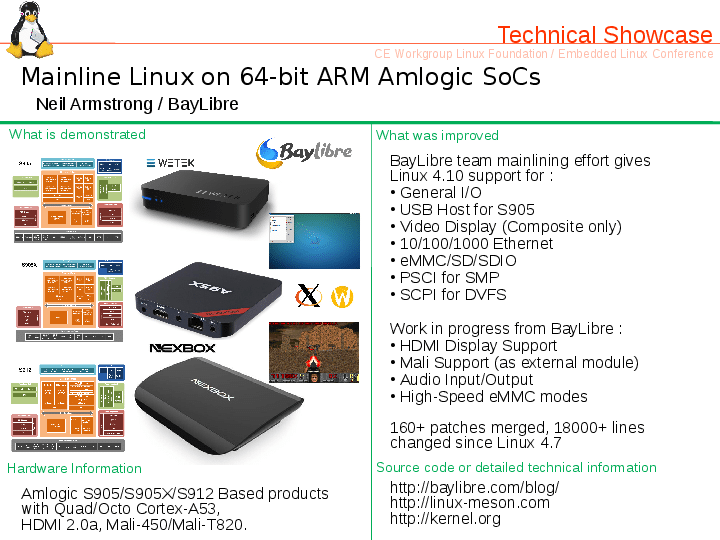
During the ELC Showcase event, BayLibre showed, among other demos, Quake III Arena running fully accelerated on an Odroid-C2 powered by the Amlogic S905 SoC.

This particular demo was running the lastest Linux 4.10 release with some in-development patches for HDMI Support, Audio and Mali acceleration that will certainly go into the next Linux releases.

The AmLogic S905 embeds an ARM Mali-450 MP3 GPU running at 750MHz.

The technical showcase poster is available as PDF Version.

Categories
Conferences ELC Frontpage Article News

BayLibre Attended ELC 2017 in Portland

Last week, BayLibre team attended the Embedded Linux Conference North America 2017 edition in Portland, Oregon.

In this particular edition, Patrick, Fabien and Neil talked about Power Instrumentation, Zephyr and Amlogic Mainline Linux status.

If you missed the event, here are the slides :


Categories
Community Frontpage Article Linux Kernel News Open-source

Linux v4.10 released, BayLibre contributions

The v4.10 release of the Linux kernel was made on February 19th, and BayLibre has (again) made the list of top 20 active employers.

An excellent summary of this release can be found at KernelNewbies, and below is a summary of our contributions, organized by SoC family and a summary graph of contributions by developer.  A special shout-out this development cycle goes to Neil Armstrong for the significant contributions of new DRM/KMS support for Amlogic SoCs.

Amlogic SoC family:

  • DT support for GXL family (S905X, S905D)
  • DT support for GXM family (S912)
  • added SD / eMMC driver
  • SDIO WLAN
  • GPIO IRQ support
  • SCPI
  • CPU DVFS (using SCPI)
  • DRM/KMS: display support (composite)

New boards:

  • Amlogic S905D P230
  • Amlogic S905X P212
  • Nexbox A95 (S905)
  • Nexbox A1 (S912)

TI DaVinci SoC family:

  • VPIF video capture: updated for DT support
  • USB: OHCI: DT support
  • USB: MUSB: DT support, host and device
  • push-buttons: supported with GPIO keys
  • fixed PLL0 rate setting
  • PWM support
  • SATA support
  • PM: suspend/resume suport for DT-based platforms

OXNAS SoCs:

  • Add SMP support
  • Add support for OX820 and Pogoplug V3
  • net: add oxnas support to DWMAC
  • pinctrl: Add SX150X GPIO Extender

Sierra Wireless SoCs:

  • Add support for WP8548 based MangOH Green board
  • Add DT base for MDM9615 SoC

Categories
Board Farm kernelci Lab Linux Kernel

Nexbox A1 serial console

The Nexbox A1 which includes an 8-core Amlogic S912 processor, is now supported in v4.10 of the Linux kernel, thanks in part to the work of BayLibre.

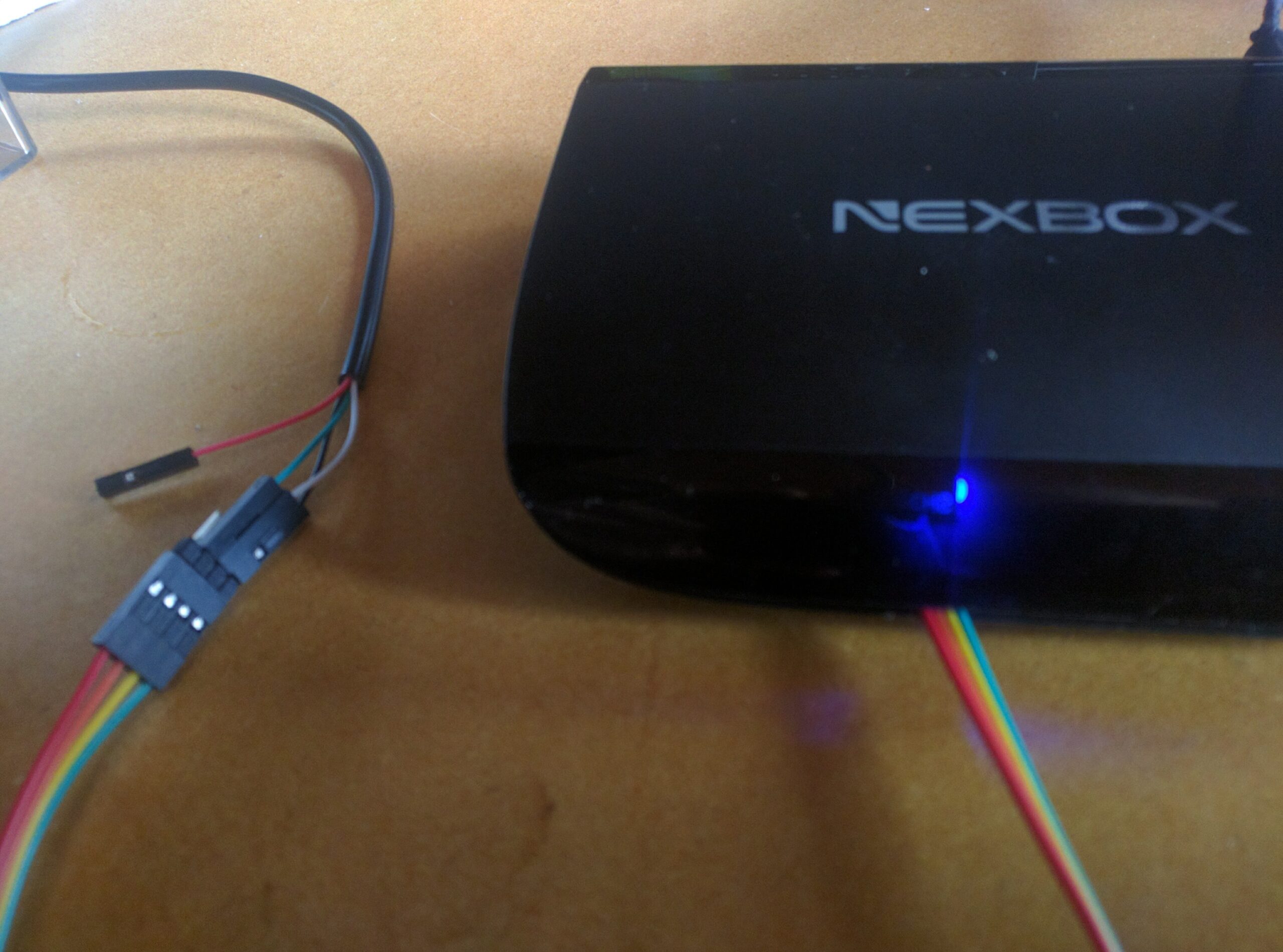
If you’d like to help with kernel development on this platform, the first think you’ll need is access to the serial console.  The serial port is not brought out to a connector, but pads are easily accessible on the main board.

Once you open the case, you’ll pads for the UART signals between the heat sink and the edge of the board.

In the photo to the right, wires have been soldered to the pads:

  • Red: VCC (not used)
  • Orange: RX
  • Yellow: TX
  • Black: Ground

Hooking the newly soldered wires up to a USB serial cable such as this one, you’ll see the boot-loader and linux kernel messages on your as soon as you power on the board.  NOTE: signal levels are 3.3V, and no need to hook up the VCC line.

Now you’ll be ready to dive in and help with kernel development on Amlogic processors.   Enjoy!

Categories
Partners

BayLibre becomes a SolidRun partner!

We’re happy to announce that BayLibre has joined the partner program at SolidRun to support customers using their best-in-class System-on-Module products.

The well-known SoMs from SolidRun support a variety of system-on-chip platforms and are supported by an open hardware carrier board. BayLibre adds world-class expertise in custom board design for these SoMs as well as porting and customizing Android, Yocto and Linux for the end product. We take the design that last mile to realize the final product.

SolidRun’s outstanding hardware products are a perfect match for BayLibre’s software world class system software expertise!

Categories
ACME Frontpage Article

ACME and pyacmegraph – Part 2 / 2

This is the second (and final) part of my series on ACME and pyacmegraph.

For the 1st post, see here: ACME and pyacmegraph – part 1 / 2

In this post I will detail pyacmegraph features and functioning.

Categories
Community Frontpage Article Linux Kernel News Open-source

Linux v4.9 released, BayLibre contributions

The v4.9 release of the Linux Kernel has just been announced, and BayLibre has made the top 20 list of companies contributing to the Linux Kernel this release.

As described in the LWN coverage, this is largely due to the inclusion of Greybus in the staging tree, but BayLibre has also been active in several other areas:

peachpitAmlogic SoC family

  • added SPI support for flash controller (spifc)
  • added USB host support
  • added PWM support
  • added secure monitor support and NVMEM
  • added watchdog support
  • added AO clocks and reset
  • added IR/remote support
  • added I2C support
  • added MHU/mailbox support
  • network: added new DWMAC glue supporting GXBB

TI DaVinci SoC family

  • added  LCDK board support
  • Audio support
  • NAND support
  • Ethernet
  • MMC/SD supported

ARM OxNAS SoC family:

  • clocksource driver updates

Fixes, cleanups for BayLibre ACME hardware:

  • gpio: pca953x: code refactoring
  • gpio: fix an incorrect lockdep warning
  • eeprom: at24: check if the chip is functional in probe()

bl-v4-9-status


Categories
ACME Frontpage Article

ACME and pyacmegraph – Part 1 / 2

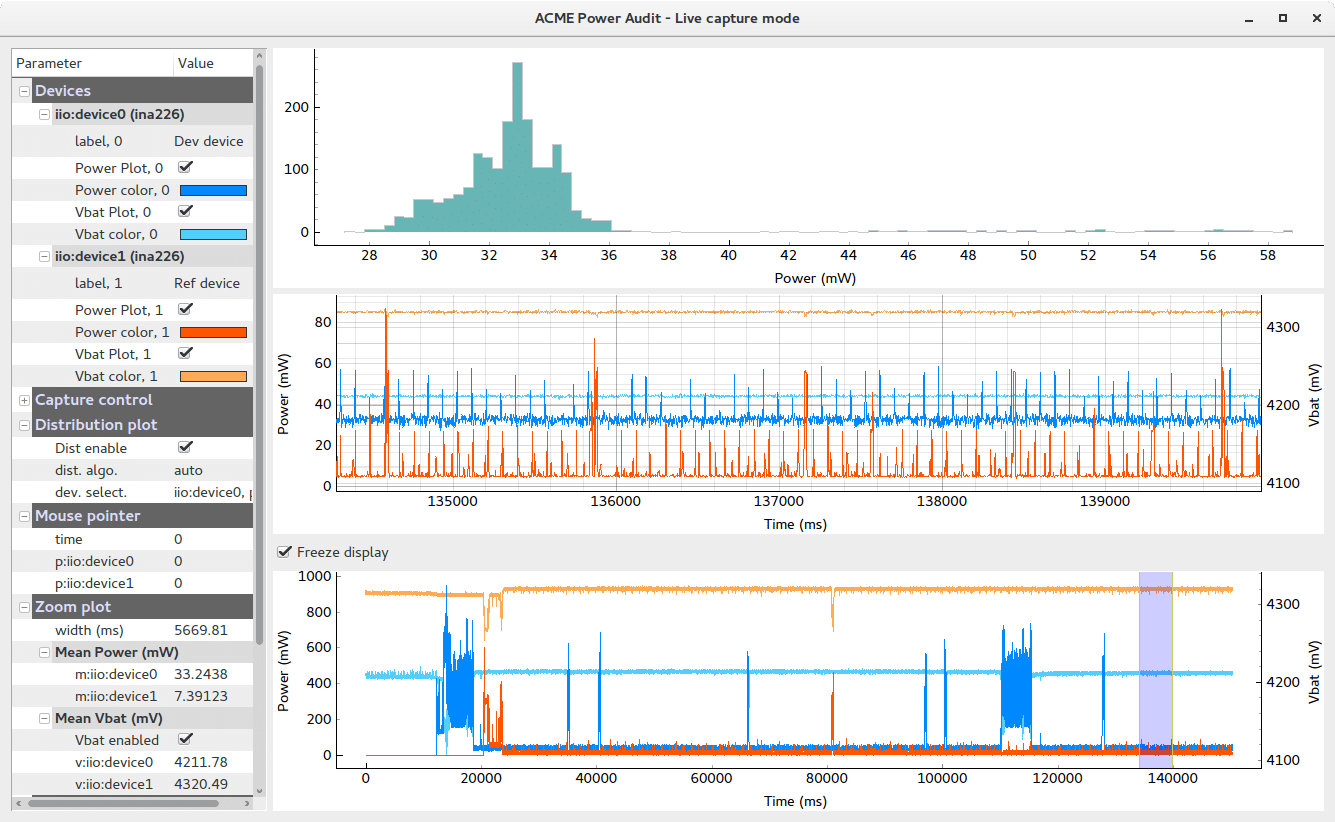
A couple of weeks ago, we made public the ‘pyacmegraph’ tool that might interest you if you use our ACME probes for power management study or debug.

This tool handles ACME probes data capture and display, with some fancy features added.
Simply put, it’s an easy to use tool that aims at getting the best of ACME for studying a device power consumption.

In this post I will introduce pyacmegraph and explain how ACME is used to measure power and send this information to pyacmegraph. In a subsequent post, I will detail pyacmegraph features and functionning.

Categories
Conferences ELC Frontpage Article

BayLibre 3rd Anniversary

October 11 was the third anniversary of the founding of BayLibre and the team celebrated in style! As usual, this anniversary occurred around the same time as Embedded Linux Conference Europe. Both the US team and the France team travelled to Berlin for the conference, delivering several talks and presentations along the way, and then enjoyed a long weekend in Wrocław, Poland to finish the team celebration.

In addition to our anniversary celebration, BayLibre has created a short video highlighting our expertise, our strengths and the ways in which we deliver value to you, the customer.

ELC-E was a great event in 2016 and BayLibre looks forward to seeing you next year in 2017!

BayLibre is a leading embedded software services provider. We develop device drivers and maintain both platforms & subsystems in the Linux kernel. BayLibre ports and customizes Android and Yocto for a variety of CE devices, including Wearables and IoT.

Categories
Community Frontpage Article Linux Kernel Open-source

BayLibre contributions to the Linux Kernel, v4.8

Version 4.8 of the Linux kernel has just been announced and you can see the always excellent summary of new features at KernelNewbies as well as an overview at LWN.net.

At BayLibre, we’re active in the kernel development community and here’s a brief summary of our contributions merged into v4.8:

Support for the Amlogic 64-bit SoCs:

  • Basic boot, DT support, timers, IRQs
  • Core drivers: clock controller, pin controller, reset controller
  • Ethernet
  • Boards: Amlogic P200 board, Hardkernel Odroid-C2 board

Misc. ARM SoC support

  • Add support for Qualcomm MDM9615
  • TI DaVinci: add support for DA850-LCDK board: NAND, SD/MMC, ethernet
  • Oxford Semiconductor OXNAS family: pinctrl, GPIO, timers

Other Drivers

  • Support to read at24 EEPROMs on BayLibre: ACME boards

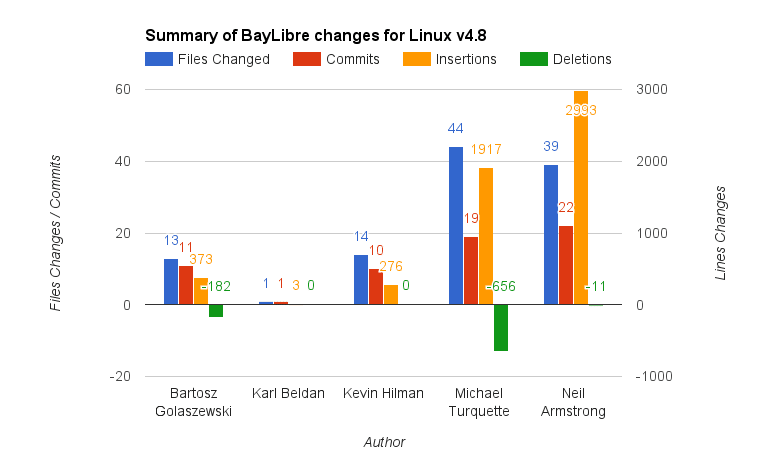
In total, 63 patches authored by BayLibre engineers were merged this cycle.  See the kernel git tree for all the details.

bl-changes-v4-8


Categories
Community Conferences Frontpage Article kernelci Linux Kernel

Kernel Recipes 2016


BayLibre was proud to be a sponsor of this this years Kernel Recipes conference in Paris.  Kernel Recipes is a small, technical conference focused on various topics related to the Linux Kernel.

I was a speaker again this year, and  gave a talk about the kernelci.org project.  The talk was a brief overview of the project, its history and ways to contribute.   Slides available here and video recordings are also available.

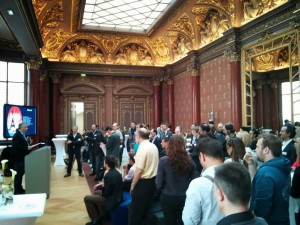
One of the fun parts of Kernel Recipes was all the speakers and some lucky audience members got caricatures of them drawn by artist Frank Tizzoni.  Here is one of me and one of the crowd, with a bunch more available on Kernel Recipes Twitter feed.


Categories
Frontpage Article

Happy New Year!

The BayLibre team wishes you a Happy New Year!

Categories
Frontpage Article News

BayLibre Goes to Washington

After opening our California office last year, people would be forgiven for thinking that BayLibre was only interested in warm beaches and sunny days. Not so! We go wherever there is strong Linux talent.
To that end we are excited to announce that our friend Kevin Hilman, based in Seattle, has joined the BayLibre team. His reputation and contributions to the Linux kernel reinforce our own dedication to improving open source software.

The BayLibre team

Categories
Frontpage Article kernelci

BayLibre contributes to kernelci.org

The BayLibre Lab is online and test results are being contributed to the kernelci.org project. In addition to standard boot tests, BayLibre is
developing a power regression test suite using LAVA and the kernelci.org infrastructure. We can’t wait to push the state of the art forward
around automated testing and quality assurance for Linux.
Marc has led the effort to bring the BayLibre Lab online. He has been supported by Kevin, Tyler, Neil and Milo from Linaro who patiently answered all of our questions about setting up the LAVA environment and integrating it with the kernelci.org project. Thanks again everyone.

Our first results are available here : http://kernelci.org/boot/all/lab/lab-baylibre/


Categories
Frontpage Article News

BayLibre will attend CES 2016

Mike will be at CES from January 6 to 9.
He’ll mostly be in Eureka Marketplace. We hope to see you there!

Categories
Frontpage Article News

BayLibre 2nd anniversary

BayLibre was really proud to celebrate its 2nd anniversary with friends and partners in both US and France. See you next year!

BayLibre team

Categories
Frontpage Article News

BayLibre goes to Hollywood

BayLibre SAS was founded two years ago at an incubator in Valbonne, France. Today, we are proud to announce the creation of BayLibre, Inc. to help grow our business and better support our customers in the US.

As part of this exciting step for BayLibre we have brought our dear friend Michael Turquette on board to take on the role of CEO and drive vision and strategy at BayLibre.

There is much to be proud of in the past two years at BayLibre and with Mike on board BayLibre 2.0 will be limitless.

The BayLibre Team

Categories
ACME ELC

BayLibre is attending Embedded Linux Conference at San Jose

BayLibre is attending ELC at San Jose this week.

Bartosz will have a talk: Sigrok: Adventures in Integrating a Power-Measurement Device.

Later we will show some ACME HW during Demo Showcase and Booth Crawl.

Last but not least, BayLibre is hiring, so if you want to meet us, we will be around.

See you there!

The BayLibre Team

Categories
ACME Frontpage Article

BayLibre ACME supported by sigrok

Thanks to Bartosz and Uwe Hermann, libsigrok now supports the BayLibre ACME device.

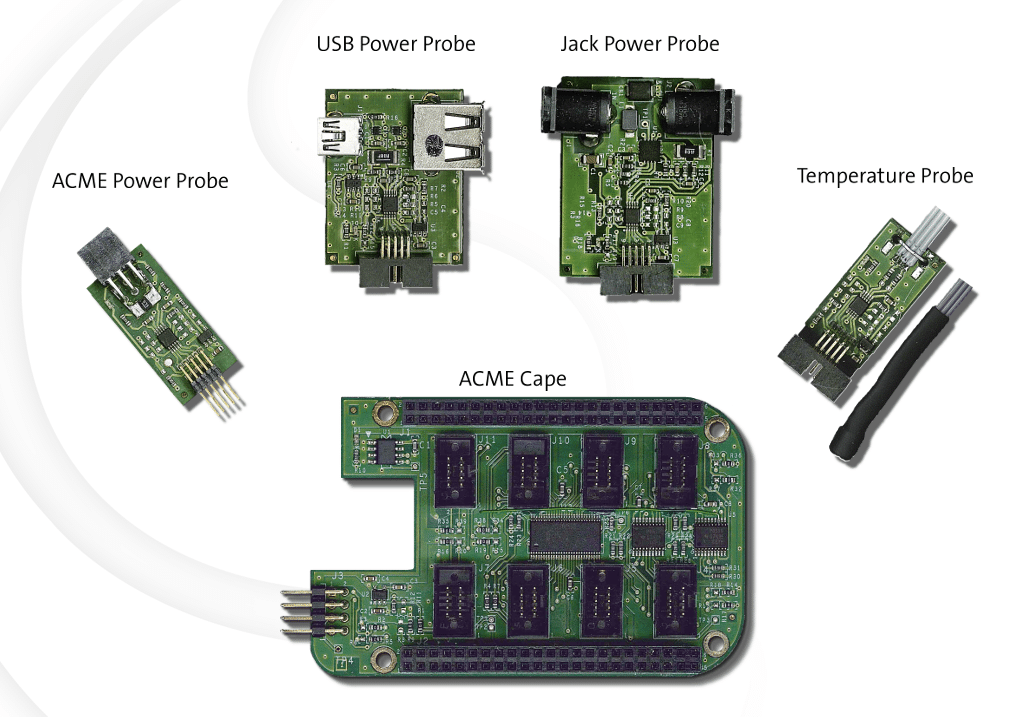
The ACME (Another Cute Measurement Equipment) is a BeagleBone Black Cape with an I²C-attached Texas Instruments INA226 current/power monitor and an I²C-attached TI TMP435 temperature sensor.

The sensors are supported in mainline Linux. The drivers expose a standard interface via the Linux sysfs pseudo file system, which the libsigrok driver uses.

Bartosz will also present a Sigrok: Adventures in Integrating a Power-Measurement Device talk at the Embedded Linux Conference on March 24, 2015 (schedule) in San Jose, CA.

Categories
Frontpage Article News

BayLibre is working on the Project Ara from Google

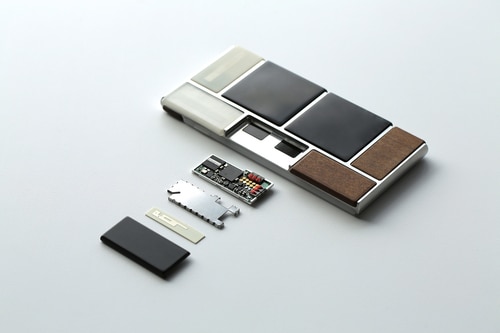
BayLibre is working on the project ARA, in collaboration with LeafLabs, Linaro and Google. The goal is to deliver a customizable and modular lego-like smartphone. The BayLibre expertise in embedded software, Linux kernel drivers and power management is a key contribution to the project.

Photo Credit Google ATAP

Project Ara is a development effort to create a modular hardware ecosystem. Put another way, Project Ara aims to enable users to create a modular smartphone that is precisely tailored to their functional and aesthetic preferences.

Learn more about ARA, Google Project 

They talk about us here

Categories
Frontpage Article News

BayLibre will attend FOSDEM 2015

BayLibre is really excited to attend FOSDEM at Bruxelles for the very first time. The agenda for the Embedded track looks pretty nice. We already registered for the Friday’s talk as well, named “Beer Distribution Algorithm v3.3 (stable)“. That sounds really technical.

BayLibre is hiring, so if you want to meet us, we will be around.

See you there!

The BayLibre Team


Categories
Frontpage Article News

BayLibre at Embedded Linux Conference Europe and Linux Plumbers

After the great Kernel Recipes in Paris 2 weeks ago, BayLibre will continue its European tour and will have the pleasure to attend two major events in Düsseldorf, Germany next week (ELCE and LPC).

The whole band will present a demo of our “Made in France” open HW running open source SW.
Later, Patrick will be on stage, playing solo, to present our latest hit : “Leveraging Open-Source Power Measurement Standard Solution“.

See you there and we’ll be happy to share some drinks backstage.

Let there be Linux!

Categories
Frontpage Article News

Kernel Recipes 2014

Kernel Recipes 2014 

BayLibre is the proud sponsor of Kernel Recipes which will take place in Paris on the 25th and the 26th of September. This is the first event we are sponsoring and here is why:

Kernel recipes is the last event where kernel hackers from all over the world can meet up free of charge. It is a place for exchange, conferences which is in phase with the original mindset of Linux and the open source community. It’s free, it’s open, the content exchanged is of good quality and it is friendly. To top it all, it takes place in Paris downtown.

Come and share kernel recipes….and a beer 🙂 with us!


Categories
Frontpage Article Images News

Developing with GIT – Training

Developing with GIT – Training.

Next training session in Sophia on July 3rd and 4rth, 1190 euros per participant.

Join us and become a Git guru.

Categories
Uncategorized

BayLibre will be at the Embedded Linux Conference in San Jose next week

BayLibre will be at the Embedded Linux Conference next week in San Jose.
Patrick Titiano will present:
“Use-Case Power Management : Identifying and Tracking Key Power Indicators – P. Titiano, BayLibre” http://sched.co/1kzhnnn
Patrick will share his expertise on this topic with the Linux audience and illustrate it with real life examples.

Categories
Partners

Skully Helmets Wins Distinguished SXSW Accelerator Award in Wearable Technology Category — Skully Helmets

Our partner Skully Helmets did it again! They have won the SXSW Accelerator Award for best #wearable technology: congratulations.

Skully Helmets Wins Distinguished SXSW Accelerator Award in Wearable Technology Category — Skully Helmets.

Categories
Frontpage Article

ARM, SBSA, UEFI, and ACPI [LWN.net]

ARM, SBSA, UEFI, and ACPI [LWN.net].

We like this article discussing whether ARM might succeed in the server space.

Categories
News

Are these heads up display products yet another Google Glass clone?

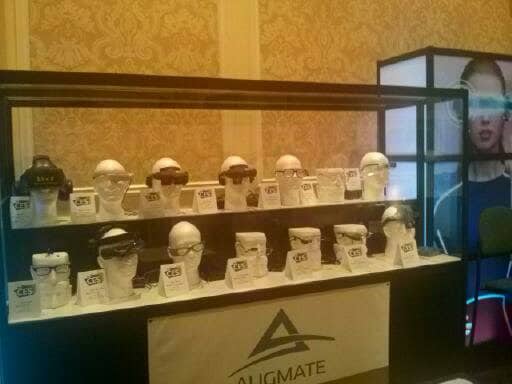
These products look at first sight like yet another clone of Google Glasses. In fact they are much more.

They are not used to surf the web while walking or to provide an augmented reality experience. Their main users are the….vision impaired. This company had the great idea to use the Google glass technology to help the people who could not read due to a lack of vision. The Glasses read out loud for them! The camera records the text read, it is transmitted to a could based reading algorithm through wireless connectivity. The interpreted text is read out loud for the vision impaired to listen.

The BayLibre team loves this usage of heads up display product. A CES 2014 marvel.

Categories
News

Did you know that BayLibre had the honor to appear in the newspaper?

A couple of months ago, we had the honor to get this great article in the newspaper and are happy to share it with you.

It is a nice and crisp description of the company, what we do and why. It is rare enough to have a journalist be so sharp that we’d like to dedicate this post to Florence.

Categories
News

And CES 2014 also showed new electrical vehicles

This vehicle is designed by a Californian startup. This is actually a prototype. It is fully electrical and should be available to buy by the end of the year. It has two wheels, can contain a single passenger and has an automated balancing system. In a curve, the vehicle will not inclined beyond 30 degrees without being balanced out by the system.


Categories
Partners

Toyota FV2 Concept Car at CES 2014

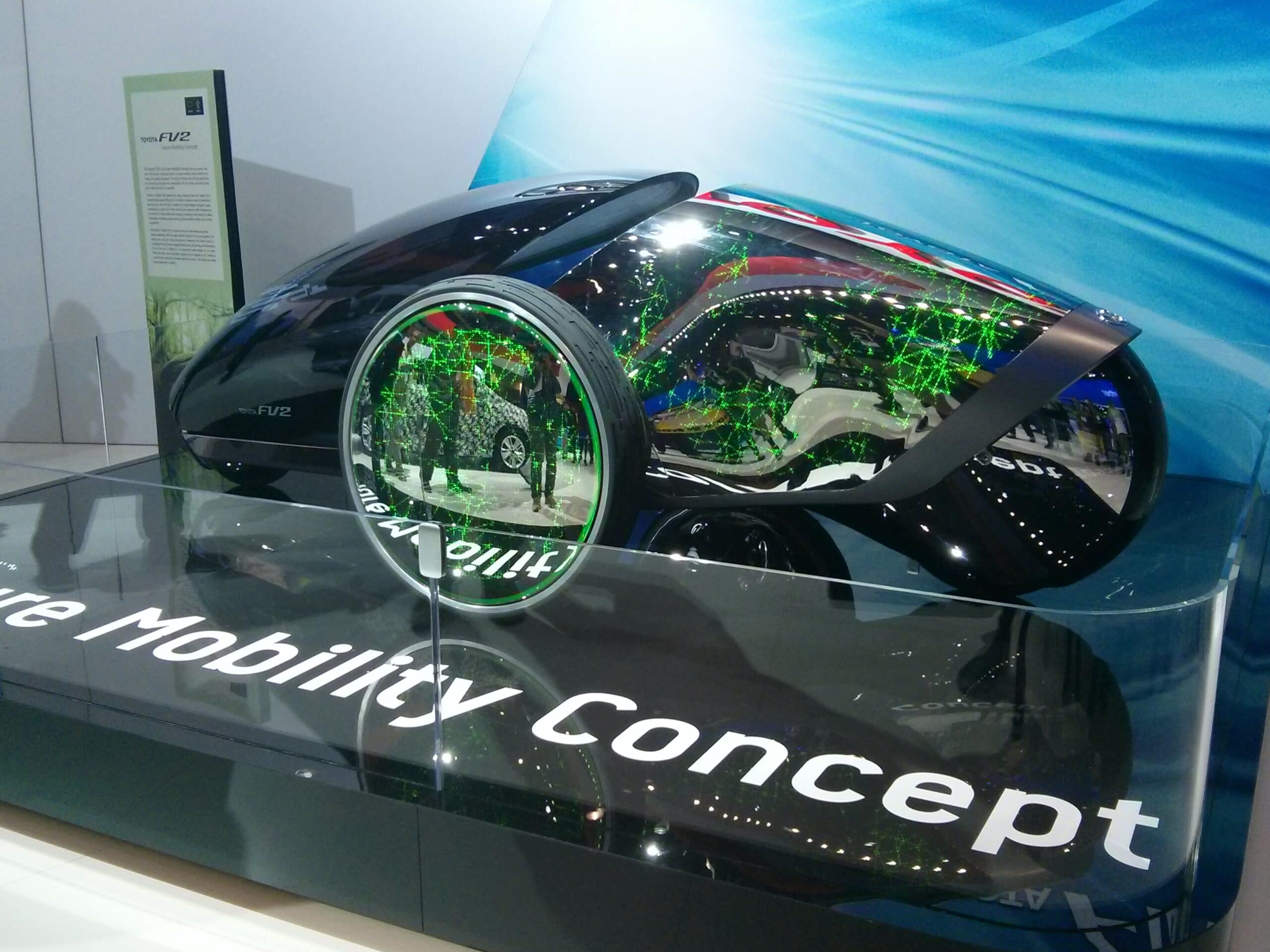
This one person car from Toyota is electrical. It is designed to bind the driver with the vehicle.

The vehicle is coated in light displays which allow the user to fully customize the appearance of the vehicle.

You can get in through an opening roof. This is almost sci-fi.


Categories
Partners

Cool Flying Dancing Drones from Parrot at CES


The metal birds are flying on the music of volare, a great demo, one of the best show of the CES2014.


Categories
News

Cool devices live from the CES

You may have heard that announcements at CES 2014 this year were all about connected devices, from tiny “Internet of Things” devices up to cars and homes, through wearable devices (smart watch, glass, clothes). Well, we wanted to check this out all by ourselves, so we sent our famous reporter, Guillene, onsite to reveal the truth to you. Guess what? It was true! Guillene reported announcements from Google (Open Automative Alliance), Audi (OOA, Audi Smart Display), Toyota (FV2), Mercedes-Benz (Intelligent Connected Car, Predictive User Experience), MyKronoz, AiQ Smart Clothes, iSmartAlarm, and many many more! See more live pictures below, and stay tuned!

Oh, one more thing: if you ever were at CES, please take the opportunity to have a chat with Guillene!


Categories
News Trainings

Open seats in January Android training session

We still have some open seats into our end-of-January training session on Android development!

In this training, you will get familiar with compiling and booting Android. You will also learn how to adapt it to support a new embedded board. You will build a complete system, see how to access specific hardware components, customize the file-system and use efficient debug techniques. You will also understand the Android software architecture and learn how to use the HAL (Hardware Abstraction Layers) to develop efficient and integrated applications. The training is split evenly between lectures and practical labs on an ARM embedded platform.

Training dates: 27 to 31 January 2014

Location: Sophia-Antipolis

Information / registration: training@baylibre.com

Categories
Images News

BayLibre wishes you and your loved one a great year 2014 !!!!!!!

Categories
Poll

Which Xmas Gift would you prefer among these 5?

These 5 cool devices embed Linux. These are all new products launched by cool start ups.

Which one would you like to have for Xmas?

[cardoza_wp_poll id=1]

Categories
Trainings

BayLibre gives Android Training in Sophia Antipolis

The Android Training session is full !!!!!!!!

The trainees will learn about Linux kernel, configuration and booting. They will master the bootloader for Android and become comfortable with the Android changes to the Linux Kernel. They will see how to support new hardware and use adb in order to control the target and much much more.


Categories
News

Patrick Titiano presents Power Management Methodology at Embedded Linux Conference

Patrick has shared the following presentation at the Embedded Linux Conference in Edinburgh.

Here is an outline:

Wireless Embedded platforms performances keep increasing (multi-core processors (MPU / GPU) up to 2GHz+, H/W accelerators, High-Speed RAM (LPDDR3, Wide I/O) & peripheral buses (USB3)). But power and thermal budgets remain roughly the same (mobile phone: ~5W, case temperature < 45oC, 1-day of active use). Hence, Power Management becomes the critical element.


http://www.slideshare.net/baylibre/use-case-power-management-optimization-elce-presentation

Categories
News

BayLibre at Embedded Linux Conference

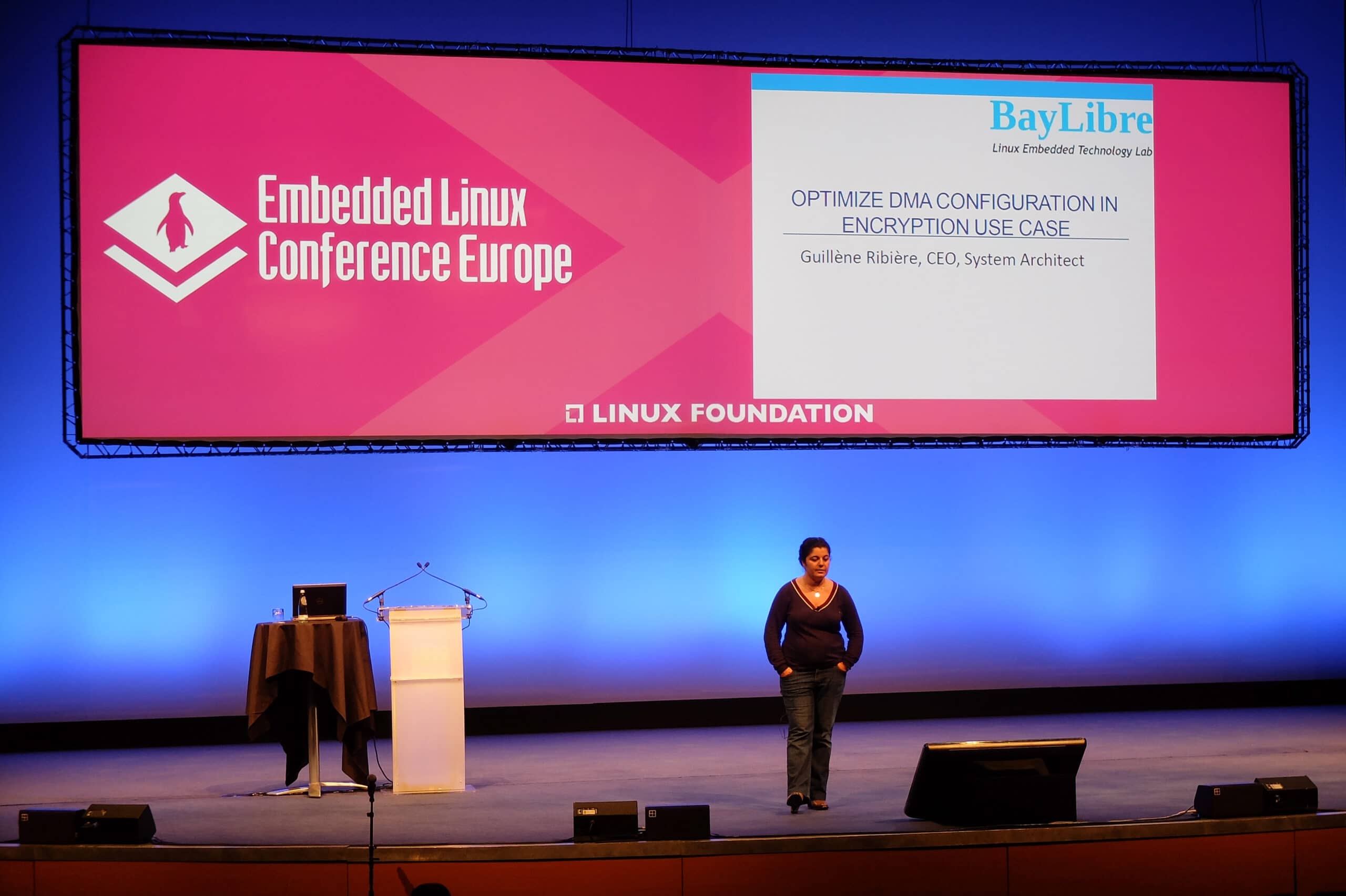
BayLibre was present at the Embedded Linux Conference in Edinburgh. A session was dedicated to sharing a hardware accelerated encryption use case analysis. This use case was based on an OMAP4 platform running Android Jellybean. The analysis consisted in understanding the performances bottlenecks and improving them.

Here are the slides which were presented:

http://www.slideshare.net/baylibre/dma-optimization-bay-libre-guillene-v4

Categories
News

Skully Helmets Video

http://www.youtube.com/watch?v=b7AYfq9uIY8

This is a cool product. We are proud to have supported the Skully Helmets team in delivering it. The BayLibre team ported Android onto the Skully hardware platform.

Categories
News

BayLibre: proud embedded software partner of Skully Helmets

BayLibre proudly announces its partnership with Skully Helmets.

This heads up display is a helmet including a rear view camera and a display.

See http://www.wired.com/autopia/2013/10/skully-helmet/ for more details.